

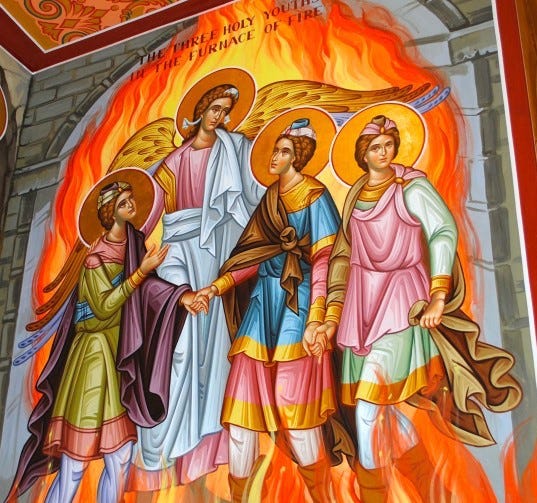
“Tell me, you three boys, remember me, I entreat you, that I also may obtain the same lot of martyrdom with you.”
“O Ananias, Azarias, and Misael, bless ye the Lord; O ye apostles, prophets, and martyrs of the Lord, bless ye the Lord: praise Him, and exalt Him above all, for ever.” We may well marvel at the words of the three youths in the furnace, how they enumerated all created things, so that not one of them might be reckoned free and independent in itself; but, summing up and naming them all together, both things in heaven, and things in earth, and things under the earth, they showed them to be all the servants of God, who created all things by the Word, that no one should boast that any of the creatures was without birth and beginning.
-St. Hippolytus, Commentary on Daniel
Debating Evidence for an Ancient Petition to the Saints
I recently presented a quote by St. Hippolytus (circa 201-211 AD) as historical evidence that the early Christians petitioned the saints in heaven. A Protestant apologist objected that St. Hippolytus was simply using a literary device in the same way he does with King Nebuchadnezzar which also appears in the commentary on Daniel. While acknowledging the poetic nature of these examples, I do think there is much more going on than mere poetry in the case of the Three Holy Youths. The following article presents a case that it is much more plausible that St. Hippolytus was directly petitioning these saints then not.
#1 Linguistic Evidence Points to Petition
T.C. Schimdt, an evangelical scholar and graduate of Yale who translated this Commentary on Daniel, writes that St. Hippolytus was directly beseeching the 3 holy youths:
“Hippolytus seems to have undertaken this commentary to comfort his fellow Christians, who, like Daniel and his three companions, suffered for their faith. For Hippolytus, suffering was not something to fear, but something to be gladly embraced. In his commentary he beseeches Shadrach, Meshach, and Abednego, ‘Tell me, you three boys, remember me, I entreat you, that I also may obtain the same lot of martyrdom with you.’ His request was fulfilled; Hippolytus suffered martyrdom in 235 AD after being exiled to Sardinia.”
Notably, there is only one other place in the commentary where St. Hippolytus uses the phrase “remember me,’ and it is in the context of petition:
“Having been grieved at this word, ‘Hezekiah turned his face to the wall and prayed to the Lord saying, ‘Lord remember me just as I have walked before you in truth and in faith and with a full heart and I have done what is pleasing in your presence.’ And Hezekiah wept with great weeping.”
Therefore, it is quite plausible that St. Hippolytus is directly petitioning the 3 holy youths when he says “remember me” before his martyrdom. Scriptorium Press actually notes how this is being used in the text:
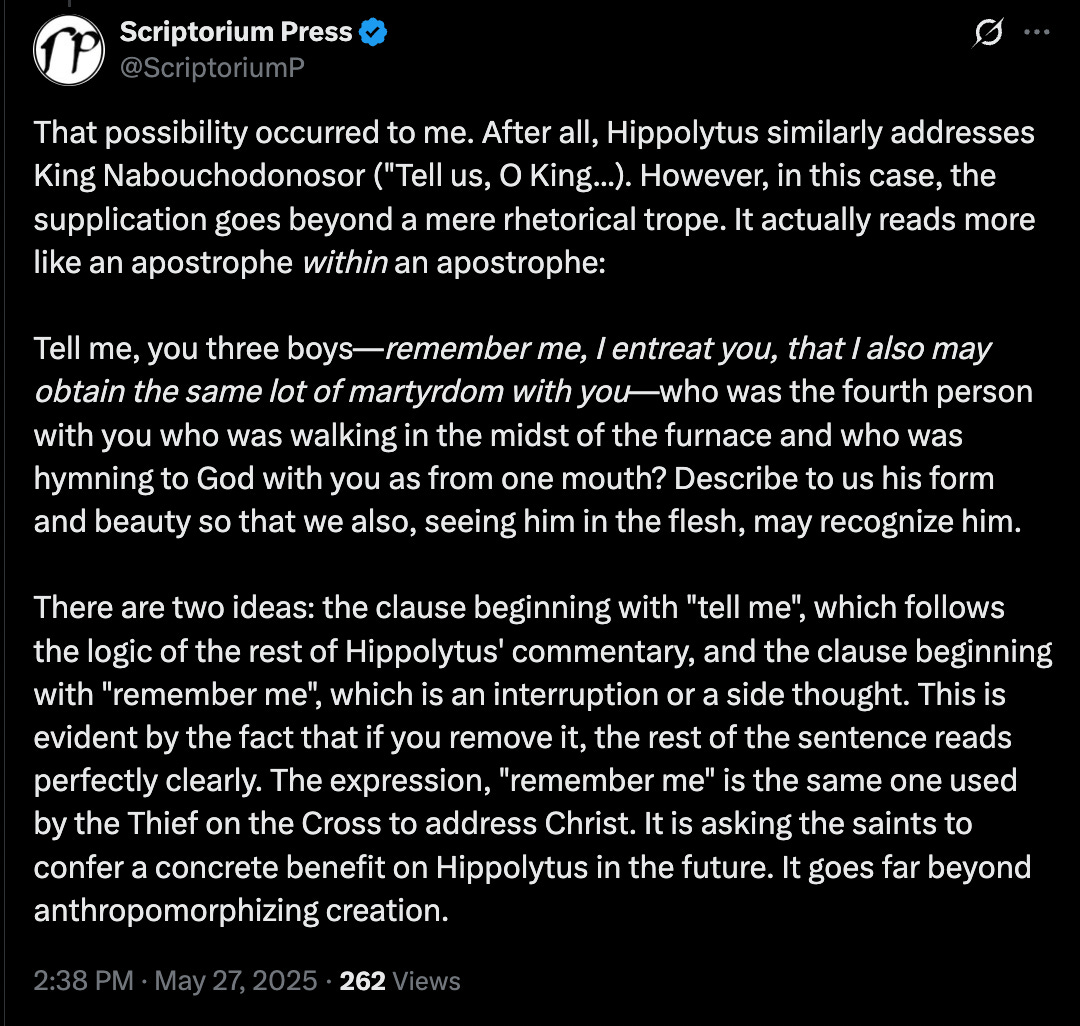
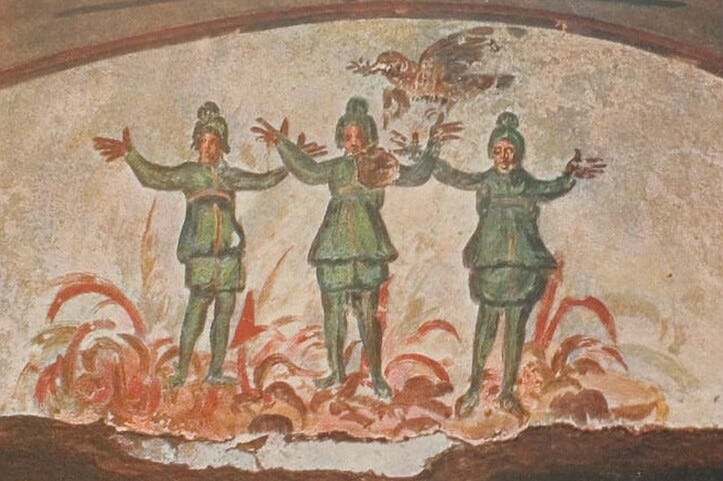
#2 Archeological Evidence Points to Petition (Catacombs, Icon)
The evidence in the catacombs only lends greater plausibility that this is a petition to the Three Holy Youths. Here is an ancient icon in the catacombs (Catacombs of Priscilla in Rome, circa 300 c.e)
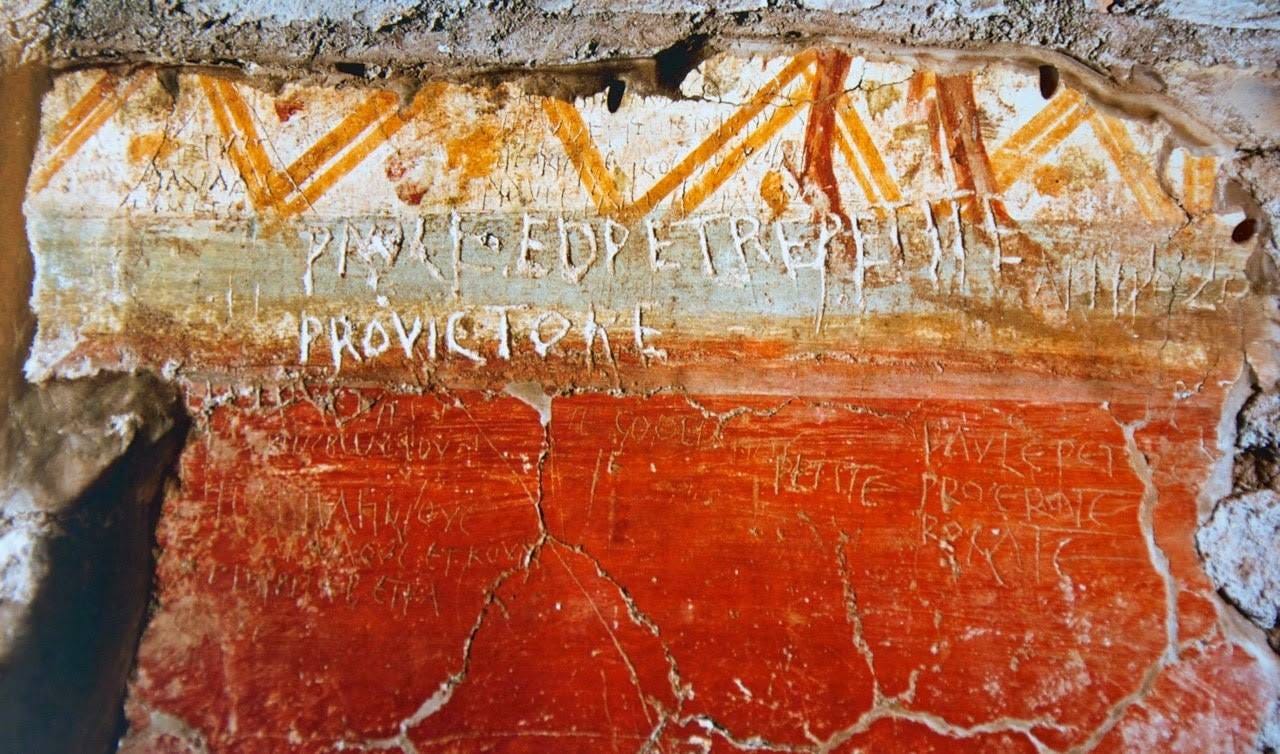
There are also mid-3rd-early-4th century catacomb graffiti (250 - 350 AD) which address the saints with the term “remember”:
Πέτρε Παίτρε μνημόνευαι | Τιμοκράτην καὶ Εὐ|τυχείαν κινα(?) καὶ | ἐσώρα(?) ++ [- - -]/‘O Peter, Peter, remember Timokrates and Eutychia, and (…) ++ [- - -]!’
Παῦλε καὶ Π[έτρε ἔχετε] / μνί[α]ς/‘O Paul and Peter, remember [- - -]!’
13055: [Παῦλε καὶ Πέτ]ρε εἰς μνε[ίαν] / [ἔχετε τὸν ᾿Ιρ]ίνες φίλι[ον]/‘O Paul and Peter, remember the beloved one of Irene.’
This is right in the range of St. Hippolytus’ petition to the Three Holy Youths.
#3 Ancient Liturgical Evidence (250-400 AD)
Anyone who has spent time in Orthodox services is aware that the 3 Holy Youths are mentioned quite often, and interestingly, this has been in the case since the early worship services of the Church. For example, the prayer of the 3 Holy Youths was one of the 9 canticles sung in daily services by the late 4th century (350-400 AD). Dr. Stephen Shoemaker writes,
“By the early Middle Ages, these nine canticles had become a fixture of the morning service, and to his day they still lie at the heart of the Eastern Orthodox morning service… From the Jerusalem Chantbook we can now see that such practice was in place in the Holy City already by the turn of the fifth century”( i.e. late 4th century, 350 -400 AD) -Dr. Stephen Shoemaker, Introduction to the First Christian Hymnal, xxxii
But why? They are were recognized as example of Christ saving them from death and as a preview of the harrowing of hades on Holy Saturday. This is why St. Hippolytus is invoking them and why they also appear in the later Jersualem chantbook.
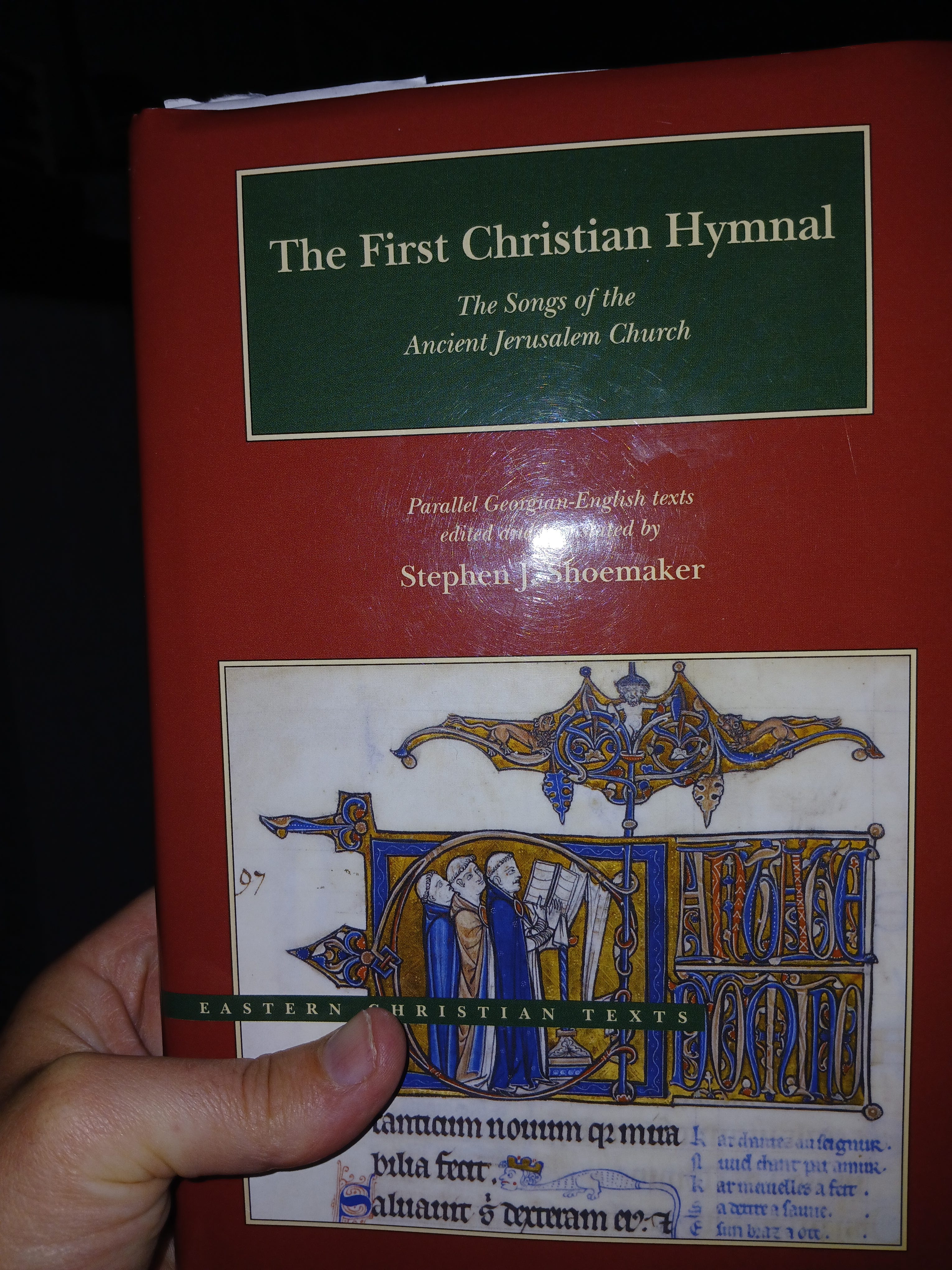
Here are a few examples:
“The youths who sing with the angels / And the furnace that brings forth dew/ Together bless you, O Lord.” (239, First Christian Hymnal)
“Glory to God in the highest / Said the youths in Babylon / Strong in faith / They blessed you, the Holy Trinity /…. The youths did not fear / The horn and music from the tyrant / But they were completeley inseperable. They saw the dinivitey in the fiery furnace / They blessed you, the Holy Trinity” (Pg. 169, First Christian Hymnal)
And it was all of the apostles, martyrs, and prophets (including Daniel and the Three Holy Youths) that were asked directly to “Intercede for our souls.”
“We have hope in Christ /And boldness from the Holy Spirit / The apostles, prophets, and martyrs, INTERCEDE for our souls.” (Pg. 165, First Christian Hymnal)
“By the INTERCESSIONS of your holy apostles, O Lord / Make peace for the sake of our salvation / Since you are God and a Lover of humankind.” (pg. 229, First Christian Hymnal)
“O Virgin Mother unwed, Who gave birth to Christ the Savior, Do not cease from praying, but INTERCED for our souls.” (pg 223, Matins, First Christian Hymnal)
“Oh pure Virgin / You are the hope and refuge of those who confess you / INTERCEDE before your Son and our God.” (pg. 147)
“The apostles announce the resurrection of Christ / The Martyrs rejoice, and they INTERCEDE for us before the Lord.” (pg. 153, First Christian Hymnal)
“O Lord, who granted peace to your apostles / You filled them with the grace of your Holy Spirit / BY THEIR PRAYERS, Oh Lord, have mercy on us." (pg. 273, First Christian Hymnal)
“You, Christ, who crowned the holy martyrs / BY THEIR PRAYERS, grant our souls / Your great mercy.” (pg 177, First Christian Hymnal)
“The Assembly of the Saints and Archangels offers you glory / You who were buried for us and arose from the dead / You illuminiated the world by your resurrection / Blessed are you unto the ages, O God of our fathers” (pg. 239, First Christian Hymnal)
St. Cyprian’s Liturgical Witness
It is also noteworthy that when St. Cyprian of Carthage introduces the importance of corporate, liturgical prayer, he references the example of the Three Holy Youths in the Old Testament! Was it because this hymn was already included in ancient, Christian collections? It seems all the more likely since he also mentions the ‘prayer of Hannah’ which was also one of the 9 canticles in the Jerusalem Chantbook (i.e. the First Christian Hymnal).
St. Cyprian (Lord’s Prayer, 250-51 AD) lists the following features regarding liturgical prayer:
1) a priest and sacrifice (i.e. Eucharist)
2) memorized, corporate prayers
3) fasting that enhances our prayers before God
4) the intercession of angels and saints before God
5) appointed times for corporate prayer (morning/matins & evening/vespers) and the 3 holy youth as example of praying together at these appointed hours.
St. Cyprian writes (Treatise 4 on the Lord’s Prayer): (free free to read or skip this lengthy quote!)
(4) "And when we meet together with the brethren in one place, and celebrate divine sacrifices with God’s priest, we ought to be mindful of modesty and discipline — not to throw abroad our prayers indiscriminately…
(8) Our prayer is public and common; and when we pray, we pray not for one, but for the whole people, because we the whole people are one. The God of peace and the Teacher of concord, who taught unity, willed that one should thus pray for all, even as He Himself bore us all in one. This law of prayer the three children observed when they were shut up in the fiery furnace, speaking together in prayer, and being of one heart in the agreement of the spirit; and this the faith of the sacred Scripture assures us, and in telling us how such as these prayed, gives an example which we ought to follow in our prayers, in order that we may be such as they were: Then these three, it says, as if from one mouth sang an hymn, and blessed the Lord. They spoke as if from one mouth, although Christ had not yet taught them how to pray. And therefore, as they prayed, their speech was availing and effectual, because a peaceful, and sincere, and spiritual prayer deserved well of the Lord. Thus also we find that the apostles, with the disciples, prayed after the Lord’s ascension: They all, says the Scripture, continued with one accord in prayer, with the women, and Mary who was the mother of Jesus, and with His brethren. Acts 1:14 They continued with one accord in prayer, declaring both by the urgency and by the agreement of their praying, that God, who makes men to dwell of one mind in a house, only admits into the divine and eternal home those among whom prayer is unanimous.”
(31) 31. Moreover, when we stand praying, beloved brethren, we ought to be watchful and earnest with our whole heart, intent on our prayers. Let all carnal and worldly thoughts pass away, nor let the soul at that time think on anything but the object only of its prayer. For this reason also the priest, by way of preface before his prayer, prepares the minds of the brethren by saying, Lift up your hearts, that so upon the people’s response, We lift them up unto the Lord, he may be reminded that he himself ought to think of nothing but the Lord.
(33) Those prayers quickly ascend to God which the merits of our labours urge upon God. Thus also Raphael the angel was a witness to the constant prayer and the constant good works of Tobias, saying, It is honourable to reveal and confess the works of God. For when you prayed, and Sarah, I did bring the remembrance of your prayers before the holiness of God. And when you buried the dead in simplicity, and because you did not delay to rise up and to leave your dinner, but went out and covered the dead, I was sent to prove you; and again God has sent me to heal you, and Sarah your daughter-in-law. For I am Raphael, one of the seven holy angels which stand and go in and out before the glory of God. Tobit 12:12-15
(34) And in discharging the duties of prayer, we find that the three children with Daniel, being strong in faith and victorious in captivity, observed the third, sixth, and ninth hour, as it were
(35) But for us, beloved brethren, besides the hours of prayer observed of old, both the times and the sacraments have now increased in number. For we must also pray in the morning, that the Lord’s resurrection may be celebrated by morning prayer. (i.e. Matins or Orthros)
Also at the sunsetting and at the decline of day, of necessity we must pray again. For since Christ is the true sun and the true day, as the worldly sun and worldly day depart, when we pray and ask that light may return to us again, we pray for the advent of Christ, which shall give us the grace of everlasting light. (i.e. Vespers)
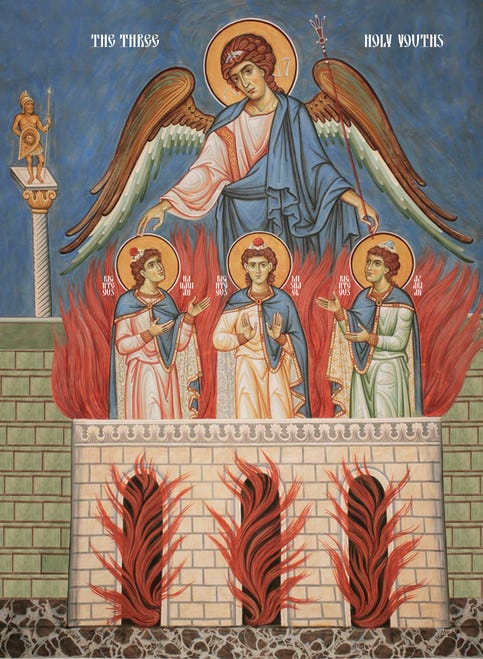
This lengthy quote demonstrates that St. Cyprian has a robust understanding of liturgical prayer and that the ‘Hymn of the 3 Holy Youths’ was most likely included in these divine services by his time (250 AD). So why does this matter?
It strengthens the plausibility that people had a devotion the Three Holy Youths early on (i.e. St. Hippolytus in 200 AD). The Church is chanting their hymn, painting their image in the catacombs, providing them as an example to imitate, and yes, asking for their petitions.
# 4 Intercession of the Martyrs
Devotion to the 3 Holy Youths in the early church also grew, because they were protected from martyrdom which was important for those who were destined for martyrdom. For example, the martyrdom of St. Polycarp points back to Daniel and the 3 Holy Youths. Dylan Pahman notes,
“We see a vivid illustration of this animosity in the Martyrdom of St. Polycarp, a letter “to all those of the holy and Catholic Church who sojourn in every place.”24 In Israel’s exile, the Babylonians threw the prophet Daniel into the lion’s den and his friends into the fiery furnace, despite their service to the king. But God stopped the mouth of the lion and “the Son of God” (Dan. 3:25) preserved the three holy youths in the flames. Similarly, when Polycarp was brought to the arena in Smyrna, the crowd “asked the Asiarch Philip that he let loose a lion on [him]. But he said . . . he had brought the wild-beast sports to a close. Then they decided to shout with one accord that he burn Polycarp alive.”25 Yet “when the flame flashed forth . . . the fire made the shape of a vaulted chamber . . . and made a wall around the body of the martyr.”26 Thus, protected from the mouth of the lion and preserved amidst the flames, “the lawless men . . . commanded an executioner to go to him and stab him with a dagger.” (pg. 117, The Kingdom of God and the Common Good)
Whether fire or beast, he knew that the Lord was His protector, and so St. Hippolytus petitioned all of heaven to “remember me.”
#5 Biblical (& 1st Century Biblical Background) Evidence
The ancient Christian practice of petitioning the saints should not surprise us since it was popular during the time of Christ (and before) to make pilgrimages to the burial shrines of Old Testament prophets and saints. We even have evidence that at least some Jews were petitioning these Old Testament saints from the 1st century document ‘Lives of the Prophets.’ Here is one example:
For the prophet’s sake [Isaiah] God wrought the miracle of Siloah; for before his death, in fainting condition he prayed for water, and it was sent to him from this source. Hence it was called Siloah, which means “sent.”… Even to the present day the water issues suddenly, to keep the miracle in mind. Because this was wrought through the prayer of Isaiah, the people in remembrance buried his body near the spot, with care and high honor, in order that through his prayers, even after his death, they might continue to have the benefit of the water.” (Lives of the Propehts, pg. 34).
This 1st century evidence also makes sense of why some thought Christ was petitioning Elijah from the cross:
“When some of those standing near heard this, they said, ‘Listen, he’s calling Elijah.’ (Mark 15:33-35).
Ironically, Christ was not crying out to St. Elijah to be saved from the cross, because he had already spoken with St. Elijah beforehand (on the Mount of Transfiguration) and received encouragement to endure the trial of the cross.
In the same way, St. Hippolytus is seeking the encouragement of the Three Holy Youths so that he might have the strength to endure the trial of martyrdom and not flee from it so that he can rise up from the flames of death and be received by the same ‘Angel of the Lord’ who is Christ our God.
May we all cry out to God and seek the intercession of the saints so that we might have the same courage and faith to pick our crosses daily and follow Him until our dying breath.
O all ye works of the Lord, bless ye the Lord: praise and exalt him above all for ever,
O ye heavens, bless ye the Lord: praise and exalt him above all for ever.
O ye angels of the Lord, bless ye the Lord: praise and exalt him above all for ever.
O all ye waters that be above the heaven, bless ye the Lord: praise and exalt him above all for ever.
O all ye powers of the Lord, bless ye the Lord: praise and exalt him above all for ever.
O ye sun and moon, bless ye the Lord: praise and exalt him above all for ever.
O ye stars of heaven, bless ye the Lord: praise and exalt him above all for ever.
O every shower and dew, bless ye the Lord: praise and exalt him above all for ever.
O all ye winds, bless ye the Lord: praise and exalt him above all for ever,
O ye fire and heat, bless ye the Lord: praise and exalt him above all for ever.
O ye winter and summer, bless ye the Lord: praise and exalt him above all for ever.
O ye dews and storms of snow, bless ye the Lord: praise and exalt him above all for ever.
O ye nights and days, bless ye the Lord: bless and exalt him above all for ever.
O ye light and darkness, bless ye the Lord: praise and exalt him above all for ever.
O ye ice and cold, bless ye the Lord: praise and exalt him above all for ever.
O ye frost and snow, bless ye the Lord: praise and exalt him above all for ever.
O ye lightnings and clouds, bless ye the Lord: praise and exalt him above all for ever.
O let the earth bless the Lord: praise and exalt him above all for ever.
O ye mountains and little hills, bless ye the Lord: praise and exalt him above all for ever.
O all ye things that grow in the earth, bless ye the Lord: praise and exalt him above all for ever.
O ye mountains, bless ye the Lord: Praise and exalt him above all for ever.
O ye seas and rivers, bless ye the Lord: praise and exalt him above all for ever.
O ye whales, and all that move in the waters, bless ye the Lord: praise and exalt him above all for ever.
O all ye fowls of the air, bless ye the Lord: praise and exalt him above all for ever.
O all ye beasts and cattle, bless ye the Lord: praise and exalt him above all for ever.
O ye children of men, bless ye the Lord: praise and exalt him above all for ever.
O Israel, bless ye the Lord: praise and exalt him above all for ever.
O ye priests of the Lord, bless ye the Lord: praise and exalt him above all for ever.
O ye servants of the Lord, bless ye the Lord: praise and exalt him above all for ever.
O ye spirits and souls of the righteous, bless ye the Lord: praise and exalt him above all for ever.
O ye holy and humble men of heart, bless ye the Lord: praise and exalt him above all for ever.
O Ananias, Azarias, and Misael, bless ye the Lord: praise and exalt him above all for ever: far he hath delivered us from hell, and saved us from the hand of death, and delivered us out of the midst of the furnace and burning flame: even out of the midst of the fire hath he delivered us.
O give thanks unto the Lord, because he is gracious: for his mercy endureth for ever.
O all ye that worship the Lord, bless the God of gods, praise him, and give him thanks: for his mercy endureth for ever.
Those 3 Hebrew boys weee not sacrificed. They never died. They went in but were suddenly accompanied by Son of God and suffered not one hair singed. This is a type of Isreal’s destiny yet ahead. The unconsumed burning bush, same type. Isreal in the flames but preserved and saved in those flames. This so-called eschatology you proclaim is false and misleading. It is Roman. Therefore without merit whatsoever.