

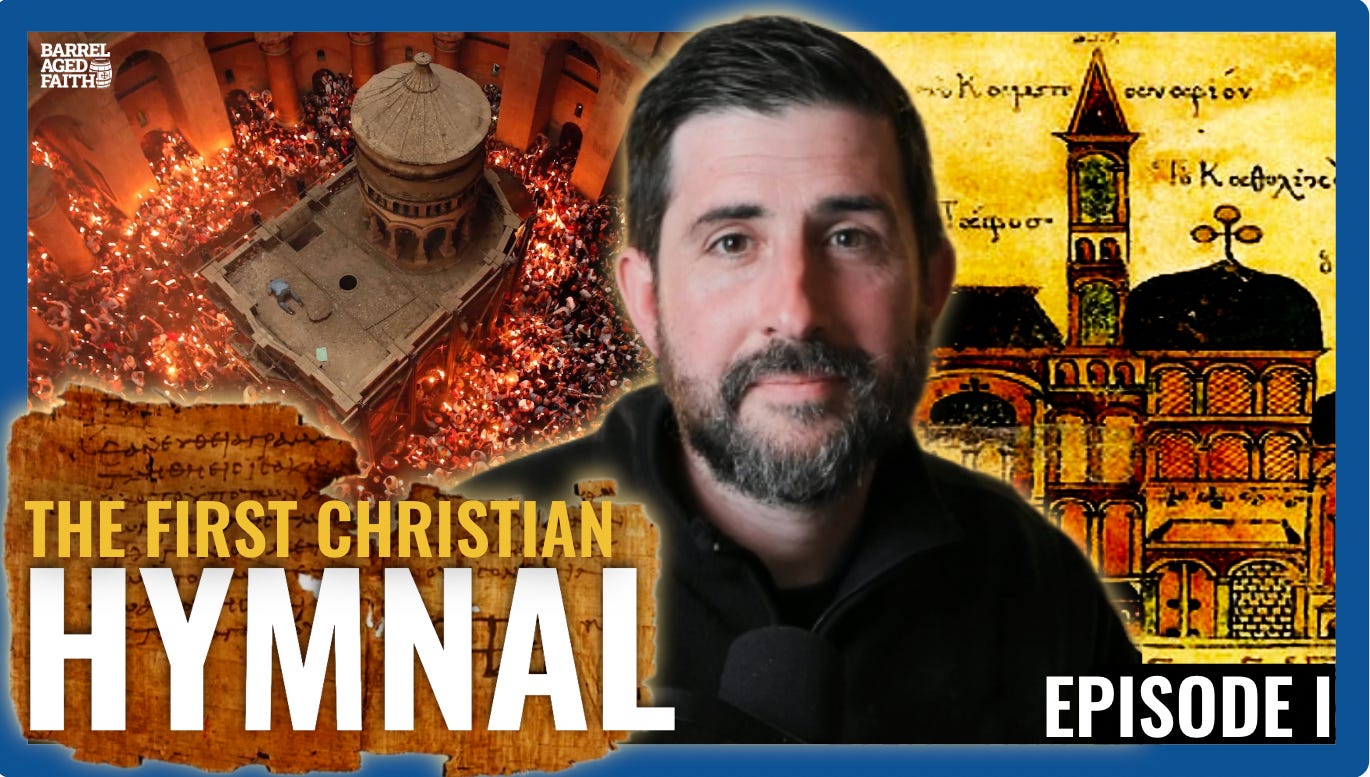
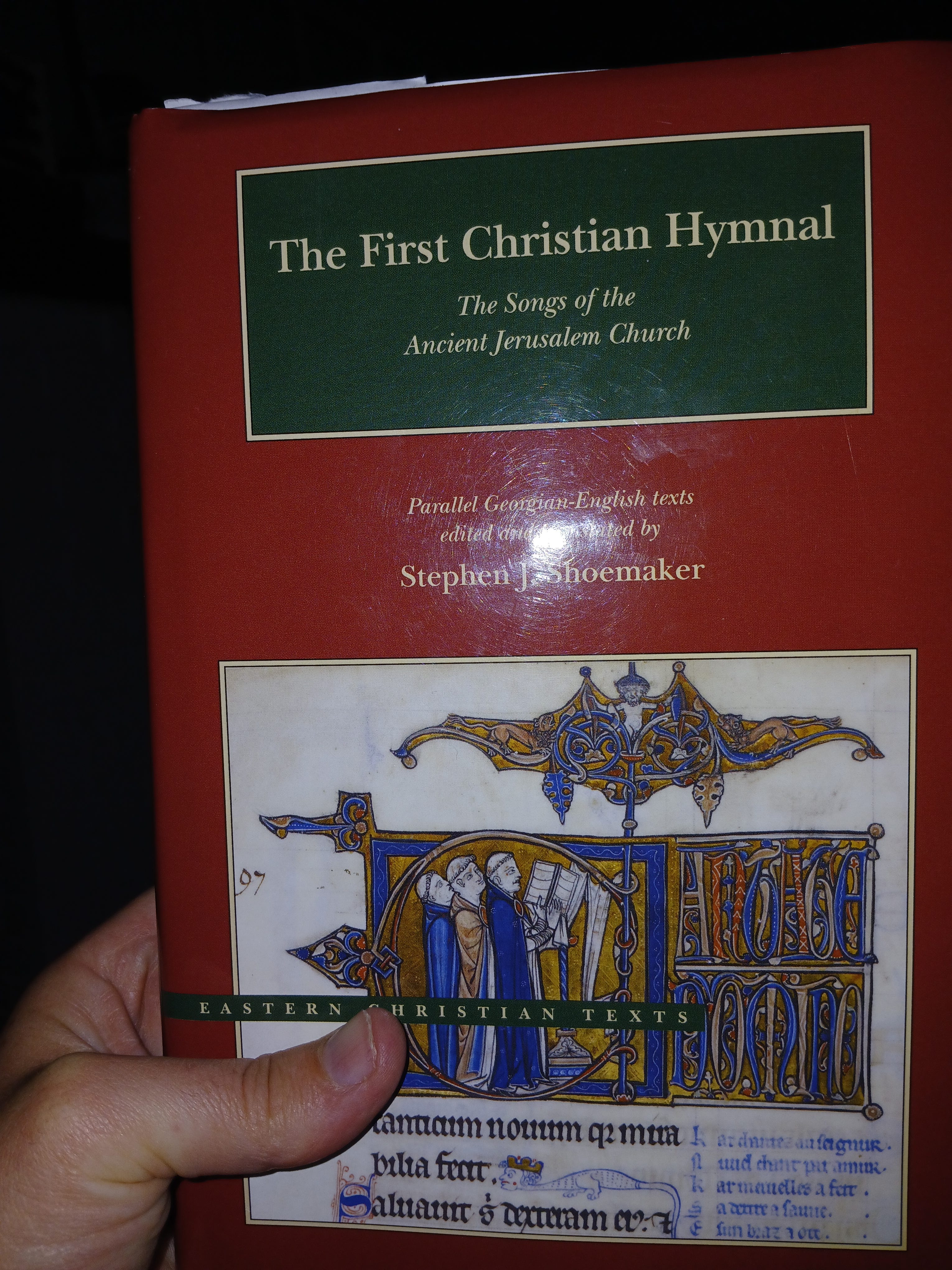
This article is the first in the series of my mini-course on the ‘First Christian Hymnal: The Songs of the Ancient Jerusalem Church,’ most of which are dated 350-400 AD. It is also simply referred to as ‘The Jerusalem Chantbook.’ In this series, we will be covering topics such as the 1) Veneration of Relics (Christ’s Tomb, Cross, & Shroud) 2) The Atonement 3) Praises & Petitions to the Theotokos & Saints 4) The Biblical Canon & References to the Deuterocanonical Texts 5) Orthodox Iconography in the Liturgy (i.e. Theotokos as the Burning Bush) 6) The Ancient Liturgical Cycle & the 9 Canticles
Introduction: The First Christian Hymnal
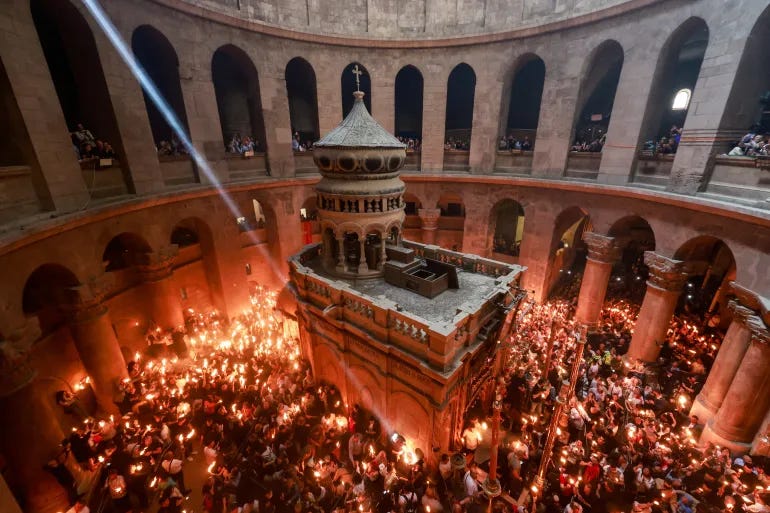
We can learn a great deal about what the early Christians believed by reading what they wrote down in their ancient hymns and chanted in the most sacred of places, particularly the Church of the Holy Resurrection (i.e. Tomb of Christ). Thankfully, Dr. Stephen Shoemaker has provided an English translation of Paschal hymns (from the Jerusalem Chantbook) that were sung in this very place! The songs were for the 40 days following Pascha (Resurrection Day or Easter) and were sung during matins/orthros (morning prayer), vespers (evening prayer), and parts of the Divine Liturgy. These manuscripts were preserved and protected by the Orthodox Church of Georgia and by God’s providence, are still with us today.
Youtube Members / Patreon / Substack (Bottom of Article)
In today’s article, we are going to take look at how the early Christians viewed the practice of venerating/honoring 1) the true tomb of Christ, 2) the true cross of Christ, and 3) the burial shroud (or linens) of Christ. The second half of today’s article is for those who support Barrel Aged Faith ($5 a month) to make this mini-course possible (both in article & video form). A special thanks to those who already support!
The True Tomb (pg. 69, 153)
The Jerusalem Chantbook declares that the “Holy Anastasis was filled with grace.” Of course, this is the Church of the Resurrection in Jerusalem (also known as the Church of the Holy Sepulchre) where Christians still gather to worship and commemorate the resurrection of our Lord Jesus Christ. Even though the Pagan Emperor Hadrian had intentionally buried this holy site from the Christians in the 2nd century and constructed a pagan temple on top of it, the early Christians continued to remember where the greatest event in human history occurred. More and more evidence has vindicated that this is the ancient site that Constantine excavated. Once a fitting church was built for this shrine to our Lord, songs were composed and collected to worship Christ for appointed times day and night.
This is what one of the hymn states:
“At the resurrection of Christ / The Heavens opened / The ends of the earth rejoiced, / Sion was beautified / The Holy Anastasis* was filled with grace / and all of the churches were filled with glory.”
Another hymn states:
“We praise you, Christ, / Who were crucified for us on Golgotha. / Your body was placed in the Anastasis* /And dead from of old / You raised up with you.”
What makes the above hymns special is that they were ‘resurrection songs’ chanted during the Paschal/Easter season in the very place that the resurrection occurred! In other words, when they sang of Christ’s glorious resurrection, they were actually looking at the empty tomb before their very eyes!
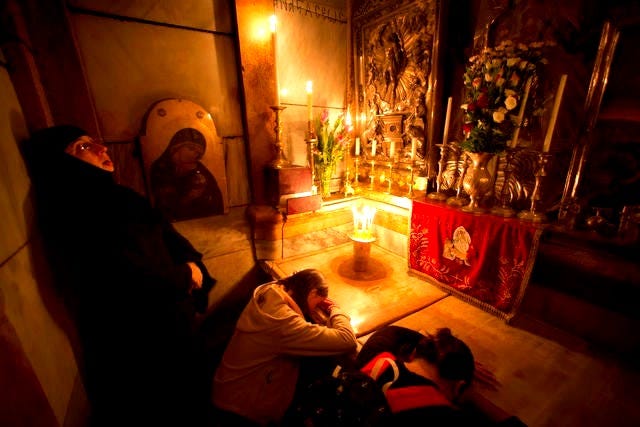
It is notable that they describe the tomb of Christ as ‘full of grace’ since they did not view the Tomb of Christ as simply a place to remember but to also encounter the grace of the Holy Spirit Whom energizes the space. This is very similar to how St. John Chrysostom describes the shrine of St. Ignatius of Antioch, the son of the apostles, who was martyred in 107 AD.
“For not the bodies only, but the very sepulchres of the saints have been filled with spiritual grace… For if in the case of Elisha this happened, and a corpse when it touched the sepulchre, burst the bands of death and returned to life again, 2 Kings 13:21 much rather now, when grace is more abundant, when the energy of the Spirit is greater, is it possible that one touching a sepulchre, with faith, should win great power; thence on this account God allowed us the remains of the saints, wishing to lead by them us to the same emulation, and to afford us a kind of haven, and a secure consolation for the evils which are ever overtaking us.” -St. John Chrysostom (Eulogy on St. Ignatius of Antioch)
From time memorial, Christians have treasured and venerated the remains of the apostles, martyrs and saints. In 155 AD, the Martyrdom of St. Polycarp tells us that the early Christians
“took up his bones, as being more precious than the most exquisite jewels, and more purified than gold, and deposited them in a fitting place, whither, being gathered together, as opportunity is allowed us, with joy and rejoicing, the Lord shall grant us to celebrate the anniversary of his martyrdom, both in memory of those who have already finished their course, and for the exercising and preparation of those yet to walk in their steps.”
This ancient Christian practice should not surprise us since it was popular during the time of Christ (and before) to make pilgrimages to the burial shrines of Old Testament prophets and saints. We even have evidence that at least some Jews were petitioning these Old Testament saints from the 1st century document ‘Lives of the Prophets.’
For the prophet’s sake [Isaiah] God wrought the miracle of Siloah; for before his death, in fainting condition he prayed for water, and it was sent to him from this source. Hence it was called Siloah, which means “sent.”… Even to the present day the water issues suddenly, to keep the miracle in mind. Because this was wrought through the prayer of Isaiah, the people in remembrance buried his body near the spot, with care and high honor, in order that through his prayers, even after his death, they might continue to have the benefit of the water.” (Lives of the Propehts, pg. 34). 1
The True Cross (pg. 81, 83, 191)
The early Christians not only wept before the tomb and honored the place he was buried, but they also came to venerate the true cross. The ‘First Christian Hymnal’ speaks of the ancient Christians venerating the cross through song:
“Protect us, Christ / By the protection of your cross / We who glorify and venerate the precious cross”
Another hymn says:
“By a tree came the fall in paradise / But here (*reference to the Church of the Resurrection), because of you, Christ, a tree is venerated / Upon which you stretched forth your hands / And raised up Adam from the fall.”
From St. Jerome, we know that the early Christians traveled to Jerusalem to honor these sites and to be close to the saints and our Lord. In 386 AD, St. Jerome (Letter 46) urges a friend to come to Jerusalem with him to kiss the cross and venerate the other holy sites.
“On what grounds, then, do men regard as blessed those spots where Peter and Paul, the leaders of the Christian host, have shed their blood for Christ?… Everywhere we venerate the tombs of the martyrs… Will the day never come when we shall together enter the Savior’s cave, and together weep in the sepulchre of the Lord…? Then shall we touch with our lips the wood of the cross, and rise in prayer and resolve upon the Mount of Olives with the ascending Lord… We shall make a pilgrimage to Samaria, and side by side venerate the ashes of John the Baptist, of Elisha, and of Obadiah.”
This pilgrimage account to Jerusalem from the Spanish nun, Egeria, (381–384 AD) also sheds more light on this practice:
“Then a chair is placed for the bishop in Golgotha behind the [liturgical] Cross, which is now standing; the bishop duly takes his seat in the chair, and a table covered with a linen cloth is placed before him; the deacons stand round the table, and a silver-gilt casket is brought in which is the holy wood of the Cross. The casket is opened and [the wood] is taken out, and both the wood of the Cross and the title are placed upon the table. Now, when it has been put upon the table, the bishop, as he sits, holds the extremities of the sacred wood firmly in his hands, while the deacons who stand around guard it. It is guarded thus because the custom is that the people, both faithful and catechumens, come one by one and, bowing down at the table, kiss the sacred wood and pass through. And because, I know not when, some one is said to have bitten off and stolen a portion of the sacred wood, it is thus guarded by the deacons who stand around, lest any one approaching should venture to do so again. And as all the people pass by one by one, all bowing themselves, they touch the Cross and the title, first with their foreheads and then with their eyes; then they kiss the Cross and pass through, but none lays his hand upon it to touch it.”
Veneration of the true cross spread throughout the world as people took splinters of wood and encased them in precious stone and metals. St. Cyril, Bishop of Jerusalem, wrote (circa 347-350 AD):
“10. He was truly crucified for our sins. For if thou wouldest deny it, the place refutes thee visibly, this blessed Golgotha683, in which we are now assembled for the sake of Him who was here crucified; and the whole world has since been filled with pieces of the wood of the Cross.” (On the 10 Points of Doctrine)
From this practice, people began to also venerate an icon of the cross in their homes and churches which Orthodox, Catholics, and some Anglicans continue to this day. Here is a story of C.S. Lewis venerating an icon of the cross:
“Lewis embraced such Catholic traditions as the Veneration of the Cross in Good Friday services. Nevertheless, when Blamires said worshiping with the Anglo-Catholics could be difficult at times because of some of their practices, L [Lewis] quickly came down on the other side: ‘Well, what for instance?’ Blamires said he loved the Good Friday liturgy overall but found the part where they ‘were expected to walk up and kneel and kiss the foot of the crucifix’ to be going too far, finally saying, ‘I couldn’t do that.’ Immediately L responded: ‘But you should. The body should do its homage.’ Blamires concluded that L was at times quite high on the Anglican spectrum and at other times rather low. It all depended upon the doctrine and the practice.”2
Lewis also placed a similar scene in his Narnia series (chapter 13 of the Silver Chair) where Aslan is honored/reverenced through one of his royal images on a shield:
“Look, friends,” he said, holding out the shield towards them. “An hour ago it was black and without device; and now, this.” The shield had turned bright as silver, and on it, redder than blood or cherries, was the figure of the Lion.
“Doubtless,” said the Prince, “this signifies that Aslan will be our good lord, whether he means us to live or die. And all’s one, for that. Now, by my counsel, we shall all kneel and kiss his likeness, and then all shake hands one with another, as true friends that may shortly be parted. And then, let us descend into the city and take the adventure that is sent us.”
The True Shroud (pg. 149)
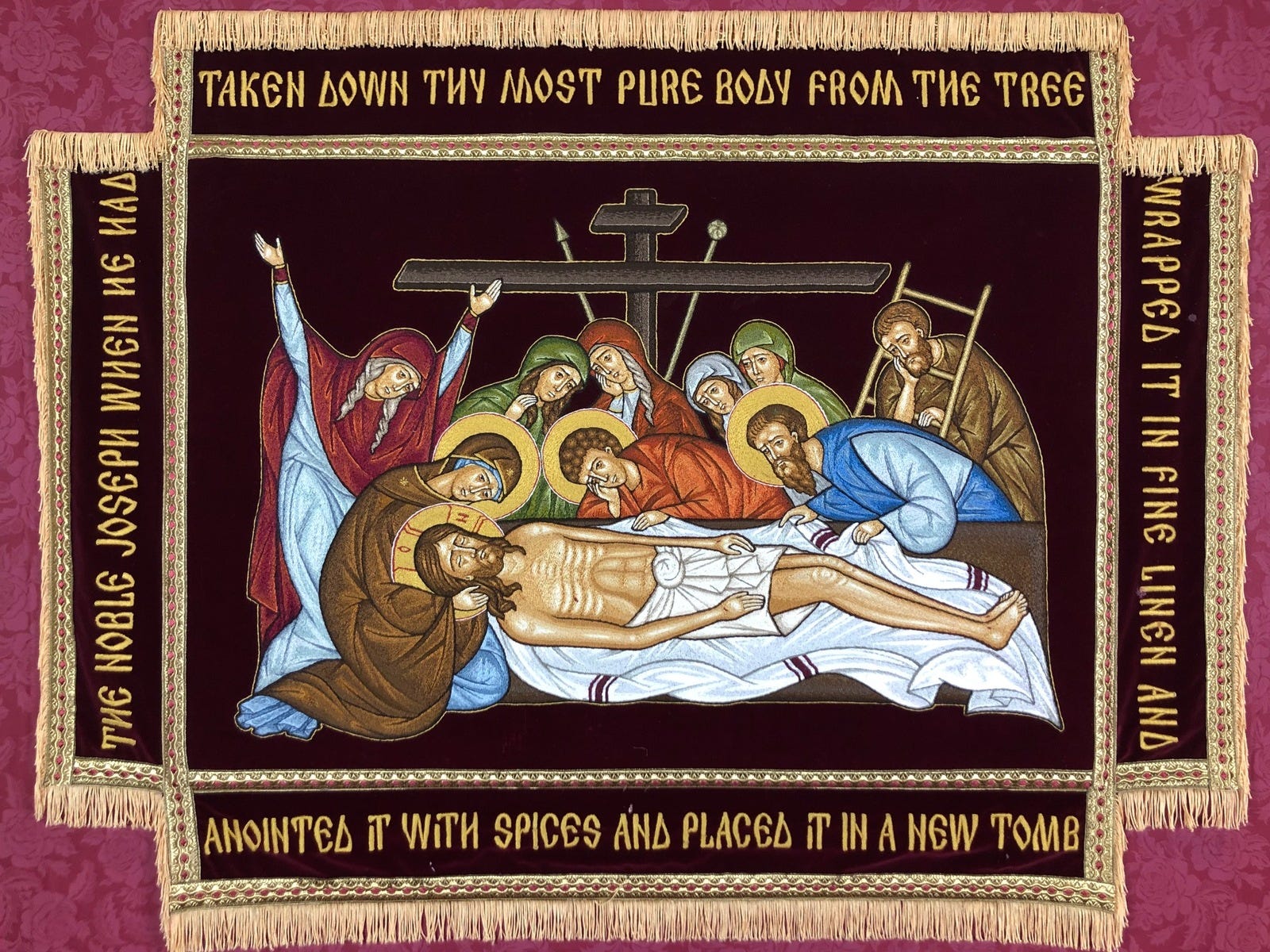
Lastly, the ‘First Christian Hymnal’ speaks of the Shroud being left behind as true evidence of his resurrection.